Best coffee scale for pour-over
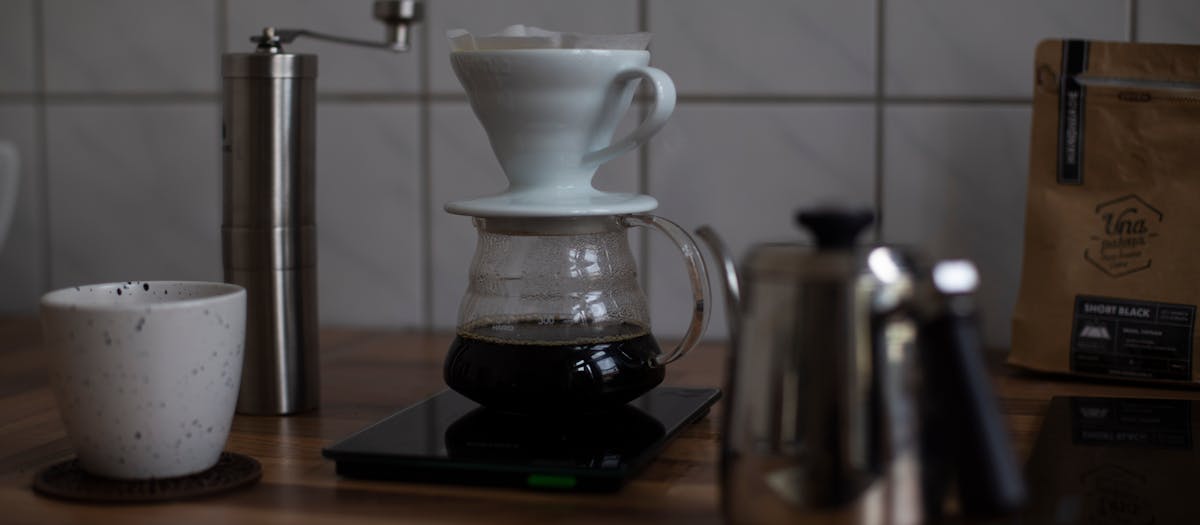
Pour-over is a recipe, and a scale is what makes the recipe repeatable. The three names most buyers weigh up are the Acaia, the Fellow Tally Pro and the Timemore Black Mirror. Acaia and the Tally Pro are currently out of stock on Amazon, so the picks below are scales you can actually buy there today — and they differ on accuracy, how fast the display keeps up with your pour, and the extras. This guide explains the five specs that matter, then points you to the picks once they are verified.
A note on how to read this. Every scale here weighs coffee accurately; the differences are in response speed, build, features and price. So the value here is the framework — what each spec changes — so you can match a scale to your budget and how much you tinker. Read the framework first, then look at the picks.
How to choose a coffee scale
Five things decide whether a scale suits you. Run any coffee scale through these — they are exactly the columns in the comparison below.
Accuracy — 0.1-gram resolution
Accuracy is the smallest weight the scale can read. Look for 0.1-gram resolution, which matters most for weighing your coffee dose, where a gram or two shifts the ratio noticeably. For the water, whole grams are plenty. A scale that reads to 0.1 grams and holds a stable reading covers everything pour-over asks of it. The accessories hub explains why weighing beats scooping.
Response time — how fast it tracks your pour
Response time is how quickly the display updates as weight changes. A fast scale lets you hit a target water weight precisely because the number tracks your pour in real time; a slow one lags, so you overshoot. For pouring water during a brew, this is one of the most useful features a coffee scale has, and a real point of difference between the budget and premium tiers.
Timer — track brew time alongside weight
Brew time is the third variable worth tracking after coffee weight and water weight. A built-in timer lets you watch weight and time together without a separate stopwatch — handy for keeping your total brew to the two-and-a-half to three minutes pour-over generally wants. Many scales include one; if not, a phone timer works, but an on-scale timer is tidier.
Max weight — it must hold your whole setup
Max weight is the most the scale can measure. It needs to cover your brewer, carafe and the water combined — a typical pour-over scale handles 2 to 3 kilograms, which is ample. Check it if you brew large batches in a Chemex, where the full vessel plus water adds up faster than a single dripper on a cup.
Size — stable footprint, easy storage
The scale needs a flat top large enough for your brewer and carafe to sit stably, and a compact footprint stores easily on a crowded counter. A travel-sized scale suits a small kitchen or taking your setup with you; a larger pad gives a Chemex more stable purchase. Match the size to your gear and your space.
The scales compared
A short list of widely available coffee scales, compared on the five specs above, from budget to premium. Specs are verified against manufacturer data and current Amazon listings, and the brew guidance follows widely-accepted SCA-style ranges — no hands-on testing claims, just the specs and the notes that decide the fit.
| Best for | Accuracy | Response time | Timer | Max weight | Size |
|---|---|---|---|---|---|
| Best overall | 0.1g, from 0.2g up to 2,000g | Not stated in listing | Built-in — Pour Over (real-time brew ratio), Espresso (auto-tare/auto-timer) and Regular modes | 2,000g | 20mm thick (23% thinner than Basic 2.0); 300g |
| Best budget | 0.1g | Not stated in listing | Built-in — auto timer for pour-over, auto timer for espresso, standard weighing | 3,000g | Not stated in listing |
| Best premium | 0.1g | Fast response with anti-drift algorithm (maker's claim; no figure given) | Built-in — Weight, Flow, Ratio and Auto modes | Not stated in listing | Not stated in listing |
| Best fast-response | 0.1g | Ultra-fast response (maker's claim; no figure given) | Built-in — five modes including pour-over timing and espresso auto-timing | 2,000g | 135 × 105 × 15.5mm (5.32 × 4.14 × 0.62 in); about 255g |
| Best compact / travel | 0.1g | Not stated in listing | Built-in — auto-detection timing plus a pour-over ratio program | 2,000g | Compact; ships with a protective transport box that doubles as a riser |
Our top picks
Best overall: TIMEMORE Black Mirror Basic 3.0 Coffee Scale with Timer, Flow Rate & Brew Ratio

Best overall
TIMEMORE Black Mirror Basic 3.0 Coffee Scale with Timer, Flow Rate & Brew Ratio
TIMEMORE
- Accuracy: 0.1g, from 0.2g up to 2,000g
- Response time: Not stated in listing
- Timer: Built-in — Pour Over (real-time brew ratio), Espresso (auto-tare/auto-timer) and Regular modes
- Max weight: 2,000g
- Size: 20mm thick (23% thinner than Basic 2.0); 300g
- Best for: Pour-over by ratio with a physical mode switch and USB-C battery
TIMEMORE's current Black Mirror: a slim 0.1g scale with a dedicated pour-over mode that calculates brew ratio as you pour, a physical mode switch and a 1600mAh USB-C battery.
Last checked 2026-10-09
Best budget: Maestri House S3 Pour Over Coffee Scale with Timer, 3kg/0.1g

Best budget
Maestri House S3 Pour Over Coffee Scale with Timer, 3kg/0.1g
Maestri House
- Accuracy: 0.1g
- Response time: Not stated in listing
- Timer: Built-in — auto timer for pour-over, auto timer for espresso, standard weighing
- Max weight: 3,000g
- Size: Not stated in listing
- Best for: Budget pour-over with ratio presets 1:1 to 1:18; USB-C battery up to 90 days
A budget 0.1g pour-over scale that takes up to 3 kg, sets coffee-to-water ratios from 1:1 to 1:18, auto-starts its timer and runs up to 90 days per USB-C charge.
Last checked 2026-10-09
Best premium: BOOKOO Themis Ultra Coffee Scale with Timer, Flow Rate, Ratio and Auto Mode

Best premium
BOOKOO Themis Ultra Coffee Scale with Timer, Flow Rate, Ratio and Auto Mode
BOOKOO
- Accuracy: 0.1g
- Response time: Fast response with anti-drift algorithm (maker's claim; no figure given)
- Timer: Built-in — Weight, Flow, Ratio and Auto modes
- Max weight: Not stated in listing
- Size: Not stated in listing
- Best for: App-connected brewing (BOOKOO and Beanconqueror apps); IP67 waterproof; 2000mAh battery
A premium Bluetooth scale that syncs live weight and flow graphs to the BOOKOO and Beanconqueror apps, with ratio and auto modes, an IP67 sealed body and a 2000mAh battery.
Last checked 2026-10-09
Best fast-response: FELICITA ARC Coffee Scale, Espresso and Pour-Over Scale with Timer

Best fast-response
FELICITA ARC Coffee Scale, Espresso and Pour-Over Scale with Timer
FELICITA
- Accuracy: 0.1g
- Response time: Ultra-fast response (maker's claim; no figure given)
- Timer: Built-in — five modes including pour-over timing and espresso auto-timing
- Max weight: 2,000g
- Size: 135 × 105 × 15.5mm (5.32 × 4.14 × 0.62 in); about 255g
- Best for: Fast feedback during pour-over; Bluetooth app logging; 1100mAh USB-C battery
A slim anodised-aluminium scale built around fast readings, with five modes including pour-over timing, Bluetooth app logging and a 1100mAh USB-C battery.
Last checked 2026-10-09
Best compact / travel: WACACO Exagram Pro Coffee Scale with Timer and Carrying Box

Best compact / travel
WACACO Exagram Pro Coffee Scale with Timer and Carrying Box
WACACO
- Accuracy: 0.1g
- Response time: Not stated in listing
- Timer: Built-in — auto-detection timing plus a pour-over ratio program
- Max weight: 2,000g
- Size: Compact; ships with a protective transport box that doubles as a riser
- Best for: Travel and small counters; 700mAh USB-C battery, up to 24 hours per charge
A compact 0.1g scale from travel-coffee maker WACACO, with a pour-over ratio program, auto timing and a hard carrying box that protects it in a bag.
Last checked 2026-10-09
Who should buy what
The first-scale buyer
A Timemore Black Mirror is the value default — accurate, responsive enough, with a timer and a sensible footprint at a modest price (the Maestri House S3 goes cheaper still). It is more than enough to brew by weight and learn from every cup, which is the whole reason to own a scale.
The everyday enthusiast
The Felicita Arc steps up the build — a slim anodised-aluminium body built around fast readings — with the features most home brewers actually use, sitting between the budget and premium tiers. If you want a scale that looks and feels the part on the counter without going pro, this is the middle path.
The precision tinkerer
An app-connected scale like the BOOKOO Themis Ultra adds live flow graphs, logging and a sealed, waterproof body — the choice if you brew competitively, log everything, or simply want the best. It is more than most pour-over drinkers need, but a genuine pleasure for those who use what it offers.
Completing the setup
A scale is the piece that ties the whole pour-over recipe together — grind, temperature and now weight. If you have arrived here last, your setup is essentially complete. If you are still assembling it, the brewer is where the cup's style is decided: see the best pour-over coffee maker guide, and the beginner guide walks the whole first setup in order, with the ratio and water-temperature cheat sheet.
Frequently asked questions
Do I need a scale for pour-over coffee?
Yes, if you want repeatable coffee. Pour-over is a recipe, and a scale lets you weigh your beans and water to the gram so a great cup can be made again and a bad one diagnosed. Scoops and eyeballed pours vary too much to learn from. A scale is the accessory I would buy first.
What accuracy do I need in a coffee scale?
Look for 0.1-gram resolution. That precision matters most for weighing your coffee dose, where a gram or two changes the ratio noticeably. For the water, whole grams are fine. A scale that reads to 0.1 grams and holds a stable reading covers everything pour-over asks of it.
Why does response time matter on a coffee scale?
Response time is how quickly the display keeps up as you pour. A fast scale lets you hit your target water weight precisely because the number tracks your pour in real time; a slow one lags, so you overshoot. For pouring water during a brew, fast response is one of the most useful features a coffee scale has.
Is the Acaia worth the extra money over a Timemore?
For most home brewers, a Timemore Black Mirror does everything pour-over needs at a fraction of the price. The Acaia adds very fast response, refined build, app features and pro-level polish — genuinely nice, and the choice if you want the best and use those features. The Fellow Tally Pro sits between them on price and features.
Should a coffee scale have a built-in timer?
It helps. Brew time is the third variable worth tracking after coffee weight and water weight, and a scale with a timer lets you watch weight and time together without a separate stopwatch. Many pour-over scales include one. If yours does not, a phone timer works — but an on-scale timer is tidier.
What size scale is best for pour-over?
Small enough that your brewer and carafe sit on it stably, with a flat top and enough surface for a Chemex or a dripper-on-cup. A compact footprint also stores easily. Check the max weight covers your full setup plus water — a typical pour-over scale handles 2 to 3 kilograms, which is ample.
Can I use a kitchen scale instead of a coffee scale?
You can start with one, but most kitchen scales read only to whole grams and respond slowly, so you lose the dose precision and the real-time pour tracking that make pour-over repeatable. A 0.1-gram coffee scale with fast response and a timer is purpose-built for the job, and the difference is noticeable once you brew by weight.